

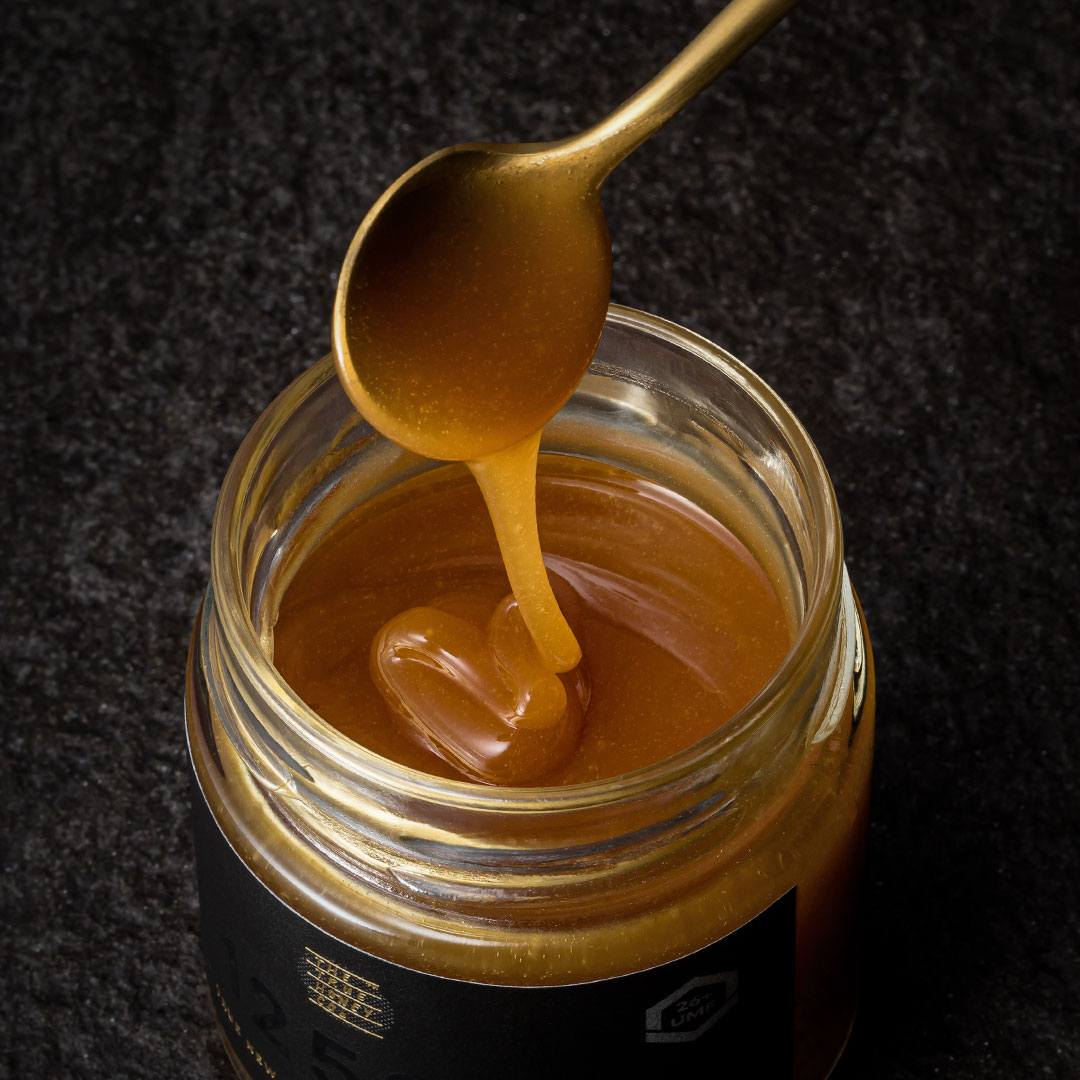
The supermarket jar and the £1,500 jar can't both be right. Here's what actually matters when choosing Mānuka honey.
Mānuka honey has become one of the most talked-about natural products in the world. It's also one of the most misunderstood. Walk into any supermarket and you'll find jars labelled "Mānuka" sitting alongside regular honey, priced just a few pounds more. Search online and you'll find jars of the same product selling for hundreds, and in some cases, over a thousand pounds.
The price difference isn't random, and it isn't just branding. It reflects a genuine, measurable difference in quality, potency, and value. But unless you understand the grading system and know what to look for, it's almost impossible to tell what you're actually buying.
So let's clear it up.
What Makes Mānuka Different
All honey has some natural antibacterial properties, mainly thanks to hydrogen peroxide produced by an enzyme that bees add during production. Mānuka honey has that too, but it also contains something else: methylglyoxal, or MGO.
MGO is a naturally occurring compound found at unusually high concentrations in honey made from the nectar of the Mānuka bush (Leptospermum scoparium), which grows in New Zealand. It's this compound that gives Mānuka honey its distinctive character and sets it apart from regular honey, and unlike some of honey's other natural properties, it doesn't break down over time or with heat, which is part of why it's so prized and carefully graded.
The relationship between MGO content and Mānuka honey's unique properties has been extensively studied and documented in peer-reviewed research, confirming that MGO concentration is the key differentiator between ordinary honey and genuine high-grade Mānuka.
The higher the MGO concentration, the more potent the honey. And here's where the grading system comes in.
Understanding MGO and UMF
You'll see two main grading systems on Mānuka honey labels: MGO and UMF.
MGO is straightforward. It measures the concentration of methylglyoxal in milligrams per kilogram. A jar labelled MGO 300+ contains at least 300mg/kg of methylglyoxal. A jar labelled MGO 1000+ contains at least 1,000mg/kg. The higher the number, the more potent the honey.
UMF (Unique Mānuka Factor) is a broader quality mark administered by the UMF Honey Association in New Zealand. It tests for multiple markers, including MGO, leptosperin (which confirms the honey genuinely comes from Mānuka nectar), and HMF (which indicates freshness). A UMF rating provides a more comprehensive quality picture than MGO alone.
The two scales roughly correlate: UMF 10+ is approximately MGO 300+, UMF 15+ is around MGO 500+, and UMF 20+ corresponds to MGO 850+. But UMF tells you more, because it verifies authenticity and freshness as well as potency.
Why Most Supermarket Mānuka Isn't Worth The Premium
Here's the uncomfortable truth about much of the Mānuka honey sold in the UK: a large portion of it is either blended, low-grade, or doesn't contain meaningful levels of MGO.
Genuine, high-potency Mānuka honey is rare. The Mānuka bush only flowers for a few weeks each year, and the conditions required for bees to produce high-MGO honey (remote, pristine environments with dense Mānuka growth) are increasingly difficult to find. Industry estimates suggest that significantly more "Mānuka honey" is sold globally each year than New Zealand actually produces. That gap is filled by blends, low-activity honey marketed under the Mānuka name, and products where the label implies more than the contents deliver.
A jar labelled "Mānuka Honey" with no MGO or UMF rating, or with a very low rating like MGO 30 or MGO 50, is unlikely to offer anything beyond what you'd get from regular honey. You're paying a premium for the name, not the function.
What Different Strengths Actually Mean
Understanding the strength spectrum helps you choose the right product for your needs.
MGO 300+ (UMF 10+) is a good entry point for daily use. This is the strength most people reach for as an everyday addition to tea, on toast, or straight from the spoon.
MGO 500+ (UMF 15+) is a step up in potency, and it's the strength many people choose when they want a more concentrated, premium honey as part of their daily routine.
MGO 1000+ (UMF 20+) is rare, premium-grade territory. Honey at this concentration is prized by serious Mānuka enthusiasts for its intensity and scarcity, and is often kept for occasional, deliberate use rather than everyday eating.
Beyond MGO 1000+, in the ultra-premium grades, you're looking at some of the rarest honey in the world, produced in tiny quantities from the most remote hive locations.
Why We Chose The True Honey Co.
When we set out to find a Mānuka honey brand for Nalu, we had clear criteria. We wanted full traceability: the ability to know exactly where the honey came from, not just that it was "from New Zealand." We wanted independently verified potency. We wanted a brand that took sustainability and ethical beekeeping seriously. And we wanted a range broad enough to serve both everyday users and those seeking the highest-potency products available.
The True Honey Co. met every criterion. Their honey is traceable to individual hive locations across New Zealand's remote landscapes. Their MGO and UMF ratings are independently tested and certified. Their range spans from accessible daily-use products like 400+ MGO squeezy honey and Mānuka honey lozenges, all the way up to their extraordinary Rare Harvest, a UMF 35.2 / MGO 2100+ Mānuka honey that represents one of the most potent honeys ever produced.
They also think carefully about how people actually use honey. Their Buzzies sachets make high-strength Mānuka portable and practical. Their lozenges, including Bluenesse and Lemon, Liquorice Root, and classic Mānuka, offer a convenient way to enjoy Mānuka honey on the go. Their Kids Everyday Wellness Set makes Mānuka accessible for families.
It's this combination of uncompromising quality and practical thoughtfulness that made The True Honey Co. a natural fit for Nalu.
How To Buy Smarter
If you take one thing from this post, let it be this: always check the MGO or UMF rating. If a jar doesn't display one, or if the rating is below MGO 100, you're not getting the properties that make Mānuka honey genuinely special. You're better off buying high-quality local honey at a fraction of the price.
If you want a great everyday honey, look for MGO 300 to 500+. If you want something rarer and more concentrated to enjoy occasionally, look for MGO 500 to 1000+.
Mānuka honey is one of nature's most remarkable products. But only when it's real, properly graded, and genuinely potent. The rest is just expensive honey.
Explore the full True Honey Co. collection or get in touch with our team for guidance on choosing the right strength for your needs.
Share:
Wearable Infrared: How Incrediwear Is Changing The Way We Think About Recovery
The Case For Ditching Plastic: Why Your Water Bottle Matters More Than You Think